
Programmer’s Digest #197
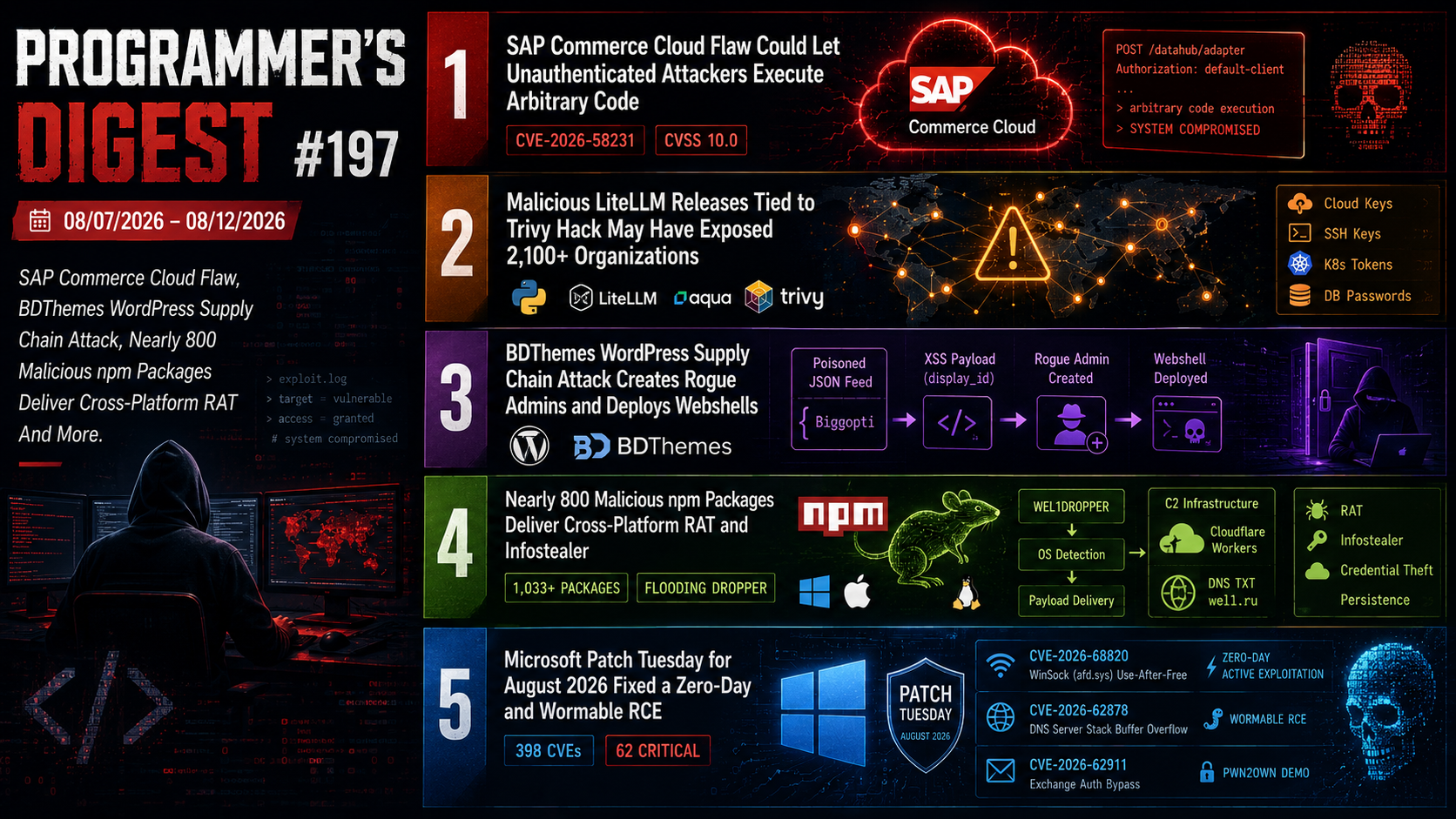
08/07/2026-08/12/2026 SAP Commerce Cloud Flaw, BDThemes WordPress Supply Chain Attack, Nearly 800 Malicious npm Packages Deliver Cross-Platform RAT And More.
1. SAP Commerce Cloud Flaw Could Let Unauthenticated Attackers Execute Arbitrary Code
SAP has released patches for a maximum-severity flaw in Commerce Cloud (Data Hub Adapter) that could enable arbitrary code execution. The bug, CVE-2026-58231 (CVSS 10.0), stems from insufficient authorization checks and input validation. CVE.org notes it lets an unauthenticated attacker abuse a default authentication client to submit crafted input to under-validated functions, compromising confidentiality, integrity, and availability. Onapsis has urged customers to patch and redeploy, with an IP Filter Set as a temporary mitigation.
SAP’s August 2026 update also fixes three other critical flaws: CVE-2026-44772 (CVSS 9.9), a code injection bug in Manufacturing Integration and Intelligence letting a low-privileged attacker trigger command execution via a vulnerable servlet fetching external content; CVE-2026-34265 (CVSS 9.8), an out-of-bounds write in NetWeaver/ABAP Platform’s DIAG protocol parsing that can leak data or crash systems; and CVE-2026-44758 (CVSS 9.1), an SSTI/SSRF flaw enabling privileged attackers to run OS commands, fixed by removing the vulnerable servlet.
2. Malicious LiteLLM Releases Tied to Trivy Hack May Have Exposed 2,100+ Organizations
Two malicious LiteLLM releases, versions 1.82.7 and 1.82.8, sat on PyPI for roughly 40 minutes on March 24 carrying credential-stealing code that harvested cloud keys, SSH keys, Kubernetes tokens, and database passwords. Threat intel firm CloudSEK says a dataset built from ~434,000 captured files maps potential exposure to over 2,500 organizations, though these are files the attackers stole, not victim-confirmed data, and CloudSEK stresses the totals aren’t a victim count. NVIDIA, Cisco, Deloitte, Volkswagen, FedEx, Siemens, and X Corp appear among matches; both CloudSEK and LiteLLM recommend rotating credentials rather than waiting for proof of misuse.
The incident is tied to a broader TeamPCP campaign (tracked as UNC6780) that also compromised Aqua Security’s Trivy scanner, force-pushing malicious commits across dozens of version tags. The FBI warned in a July advisory that stolen credentials may be weaponized long after initial compromise, urging rotation of CI/CD secrets, publishing tokens, and cloud credentials, plus checks for campaign-linked repos like tpcp-docs.
3. BDThemes WordPress Supply Chain Attack Creates Rogue Admins and Deploys Webshells
A supply chain compromise has hit WordPress plugin vendor BdThemes, letting attackers silently create rogue admin accounts and install webshells without altering any plugin code. Wordfence, alerted August 7, found threat actors poisoned a JSON banner feed (“Biggopti”) used across plugins like Element Pack, Prime Slider, and Ultimate Post Kit. The feed fetches from a DigitalOcean Spaces bucket; a stored XSS flaw in Prime Slider’s display_id field let attackers inject a payload that fires on admin page load, contacts a C2 server, creates a new admin account via the session’s REST API nonce, and uploads a disguised plugin containing a webshell. That webshell installs persistent Must-Use plugins, including a magic-login backdoor and an account-hiding module. A secondary payload generates deterministic bd_-prefixed credentials from each victim’s hostname. Wordfence links the infrastructure to prior Advanced Responsive Video Embedder and OptinMonster/TrustPulse incidents. Affected plugins were pulled; site owners should audit user lists and mu-plugins directories.
4. Nearly 800 Malicious npm Packages Deliver Cross-Platform RAT and Infostealer
Nearly 800 (now 1,033+) malicious npm packages, using AI-generated typo-squatted names, deliver cross-platform RAT/infostealer malware, per OpenSourceMalware and Sonatype (tracking it as “Flooding Dropper”). Instead of install hooks, READMEs instruct developers to load them via require(), triggering a downloader called WEL1DROPPER that detects the OS/architecture and fetches payloads from Cloudflare Workers or, as fallback, via DNS TXT records from “wel1[.]ru.” Windows payloads patch ETW/AMSI to evade monitoring; macOS uses LaunchAgent persistence; Linux deploys the Sliver C2 framework. A hidden “telemetry.js” file duplicates the downloader logic as camouflage. Domains suggest targeting of Russian financial institutions, and researchers link the campaign to April’s “Moika” dependency-confusion operation.
Separately, Unit 42 documented other npm/PyPI campaigns delivering crypto stealers, cloud credential theft, and CI/CD token exfiltration, plus Chrome extensions covertly turning browsers into residential proxy nodes via embedded bandwidth-sharing SDKs.
5. Microsoft Patch Tuesday for August 2026 Fixed a Zero-Day and Wormable RCE
Microsoft’s August 2026 Patch Tuesday fixes 398 CVEs, 62 rated Critical, including one actively exploited zero-day. CVE-2026-68820, a use-after-free in the WinSock kernel driver (afd.sys), is under active exploitation and can grant SYSTEM privileges via a race condition. The most urgent fix is CVE-2026-62878, a critical, potentially wormable Windows DNS Server stack buffer overflow allowing unauthenticated remote code execution with no user interaction—serious given how widely DNS servers are exposed.
Three more RCE bugs stand out: CVE-2026-62893 in WDS’s unauthenticated TFTP service; CVE-2026-62815 in Microsoft’s QUIC/HTTP-3 implementation, affecting an estimated 13.5 million sites; and CVE-2026-59124, a CVSS 9.8 flaw in HPC Pack Microsoft flags as “exploitation more likely.” An Exchange authentication-bypass bug, CVE-2026-62911, was demonstrated with working exploit code at Pwn2Own Berlin and could let attackers compromise every mailbox on a server. Two publicly disclosed bugs and two TPM 2.0 flaws round out the release.